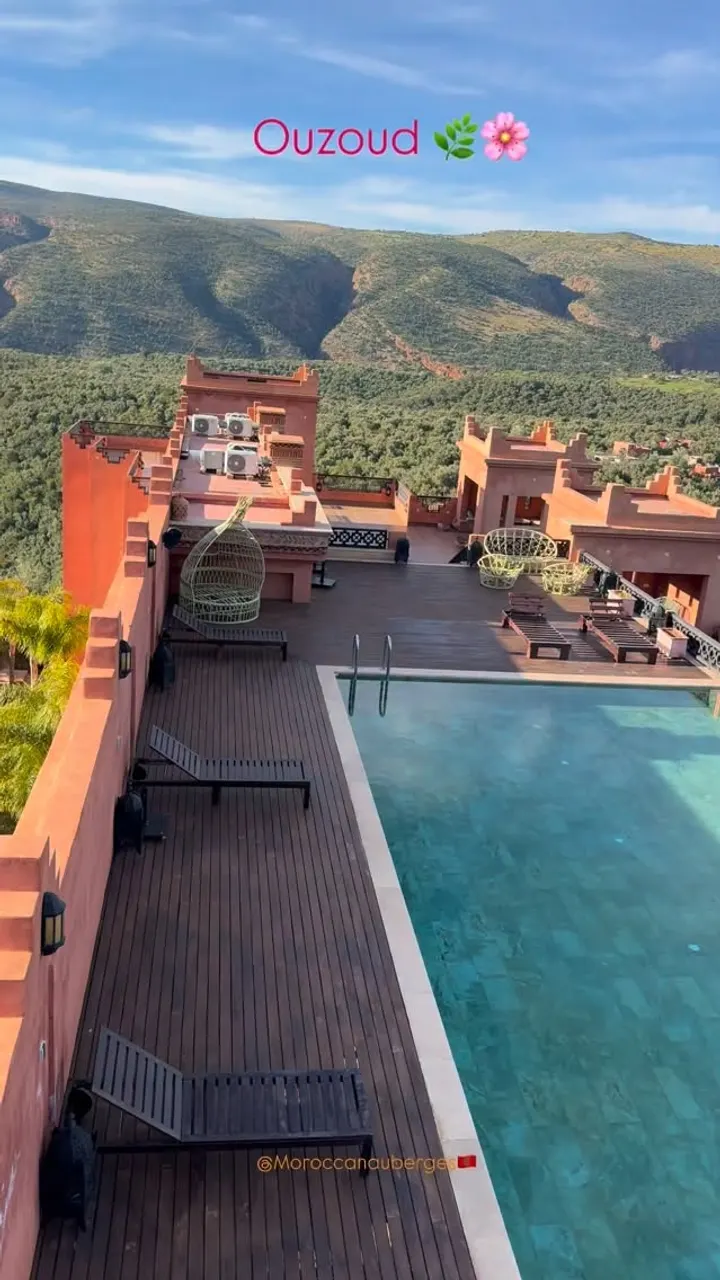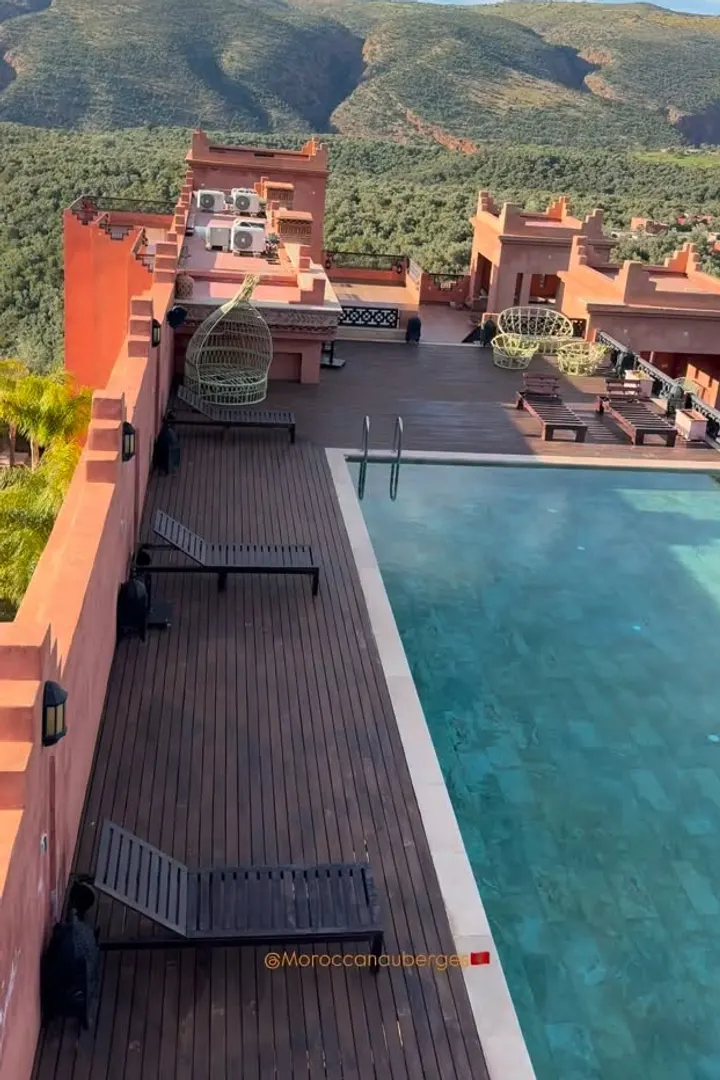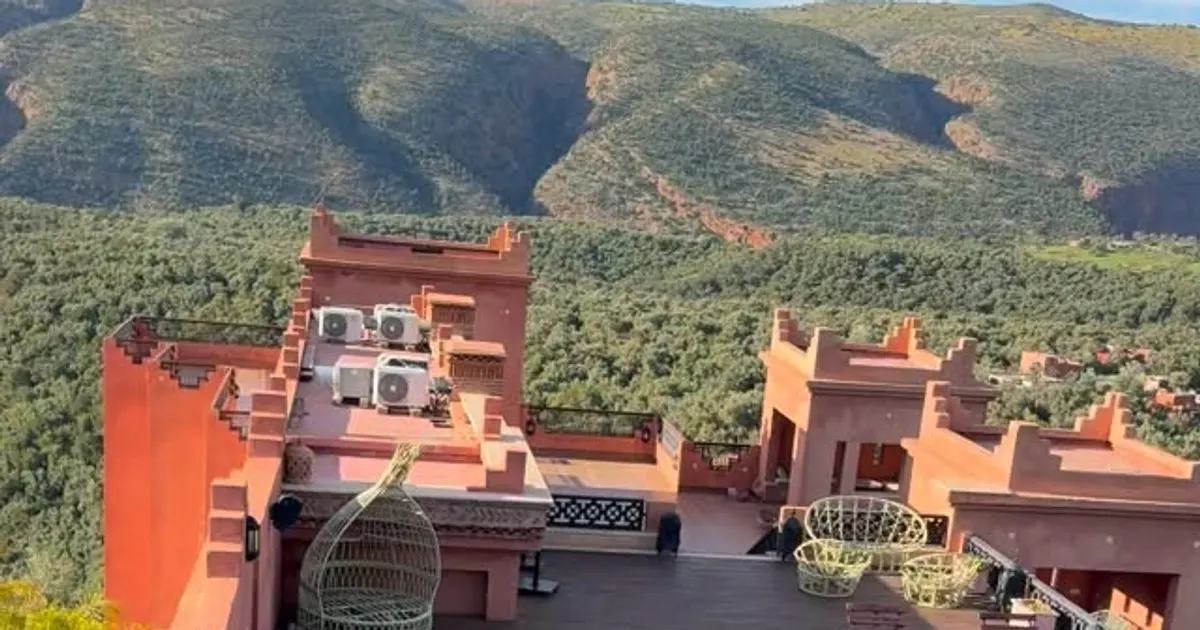
Ouzoud: sleeping by the falls, in the central High Atlas
Three tiers, about 110 metres of falling water, a rainbow that invites itself in as soon as the sun hits the right angle: the Ouzoud falls are one of Morocco’s most photographed sites, and one of its most fragile. This guide sticks to what the verifiable sources say, and points to where you can wake up looking at them.
What do the Ouzoud falls look like?
They are waterfalls of about 110 m, dropping over three tiers, on the Tissakht wadi, at 1,060 m of altitude in the central High Atlas. They empty into the gorge of the El-Abid river. Counted among the highest and most beautiful in Morocco, they are often crowned by a rainbow.
Around them the valley is green, made of red sandstone, almost an oasis: olive groves, almond, fig and carob trees. A dozen small traditional oil mills are still working there — which echoes the name of the place, “Ouzoud” meaning the act of grinding grain in Berber.
The setting is therefore a picturesque geological site, not a landscaped park: water, red rock, fruit trees and, below, the gorge. That combination, more than the height of the drop alone, is what made Ouzoud’s reputation.
Where are they, and how do you get there?
The site lies in Azilal province, about 150 km north-east of Marrakesh and 120 km from Beni Mellal. It is reached from the small town of Aït Aâtab, some 25 km away, coming either from Beni Mellal or from Marrakesh, via the sugar town of Oulad Ayad in Fkih Ben Salah province.
For a sense of driving scale, the Moroccan National Tourism Office counts 161.7 km and 2 h 40 between Marrakesh and Azilal, 278.6 km and 5 h 10 from Ouarzazate, and 305.1 km and 5 h 43 from Ifrane. Ouzoud is not a stop you improvise at the end of a day.
On site, everything happens on foot: the tourist site is entirely pedestrian. A footpath goes down to the foot of the falls, lined with campsites of simple bamboo and reed huts, bathing spots, small terrace restaurants serving Berber cooking, and High Atlas craft shops.
What else is there to see in Azilal province?
Azilal sits in the centre of the Atlas, and the town has built its offer around responsible, community-minded ecotourism. Here is what the Moroccan National Tourism Office puts on its list.
| Site | What it is |
|---|---|
| Ouzoud waterfalls | about 110 metres of falling water, over three tiers, on the Tissakht wadi |
| Imi N’Ifri natural bridge | a natural arch, near Demnate |
| Bin El Widane lake | a stretch of azure blue water |
| Ahansal wadi gorges | gorges where people come to cool off |
| Tamga nature reserve | a nature reserve of the High Atlas |
| Aït Bouguemez valley | the “valley of happy people”, under the M’goun, which peaks above 4,071 metres |
At the table, the region puts forward Amazigh couscous, fish tagine and olive tagine, cooked with argan oil, then mint tea and Moroccan pastries to recover from the walking. The office also names, among the province’s essentials, the Oued Al Abid gorges, the Tamga reserve and the ahidous dance.
The Ouzoud waterfalls rank high among Azilal’s most popular sites, alongside Bin El Ouidane, the Aït Bouguemez valley and Ain Asserdoun. Which tells you how major a tourist site this is in Morocco — and why the next question matters.
How do you visit without damaging the site?
This is the part guides usually skip. Ouzoud is classified as a site of biological and ecological interest, and yet it is increasingly spoiled by tourist activity. Three effects are documented: the behaviour of the wild Barbary macaques, now used to being fed by visitors; waste and wastewater, often dumped directly on site, notably into the wadi; and the yearly appearance of new businesses that nibble away at the vegetation sheltering local wildlife.
Three habits follow, and none of them costs anything: do not feed the monkeys, carry your rubbish back up, and choose accommodation that has not planted itself in the bed of the wadi.
Where can you stay facing the falls?
The address we know at Ouzoud is at the bottom of this page, with a link to talk it over on WhatsApp. To pick a region first, go through the six regions we cover. And if you head down to the ocean afterwards, our Imsouane guide sets you in front of a bay and a wave that runs for more than 800 metres.
Frequently asked questions
How high are the Ouzoud falls?
The falls are about 110 metres high and drop over three tiers, on the Tissakht wadi, at 1,060 metres of altitude in the central High Atlas.
How far is Ouzoud from Marrakesh?
The site is about 150 kilometres north-east of Marrakesh, in Azilal province. The Moroccan National Tourism Office counts 161.7 kilometres and 2 h 40 of driving between Marrakesh and Azilal.
Can you visit the site by car?
No: the tourist site is entirely pedestrian. A footpath descends to the foot of the falls, lined with bathing spots, small terrace restaurants and High Atlas craft shops.
What does the word Ouzoud mean?
In Berber, Ouzoud means the act of grinding grain. The name fits the place: a dozen small traditional oil mills are still working in the valley.
Stays from this guide