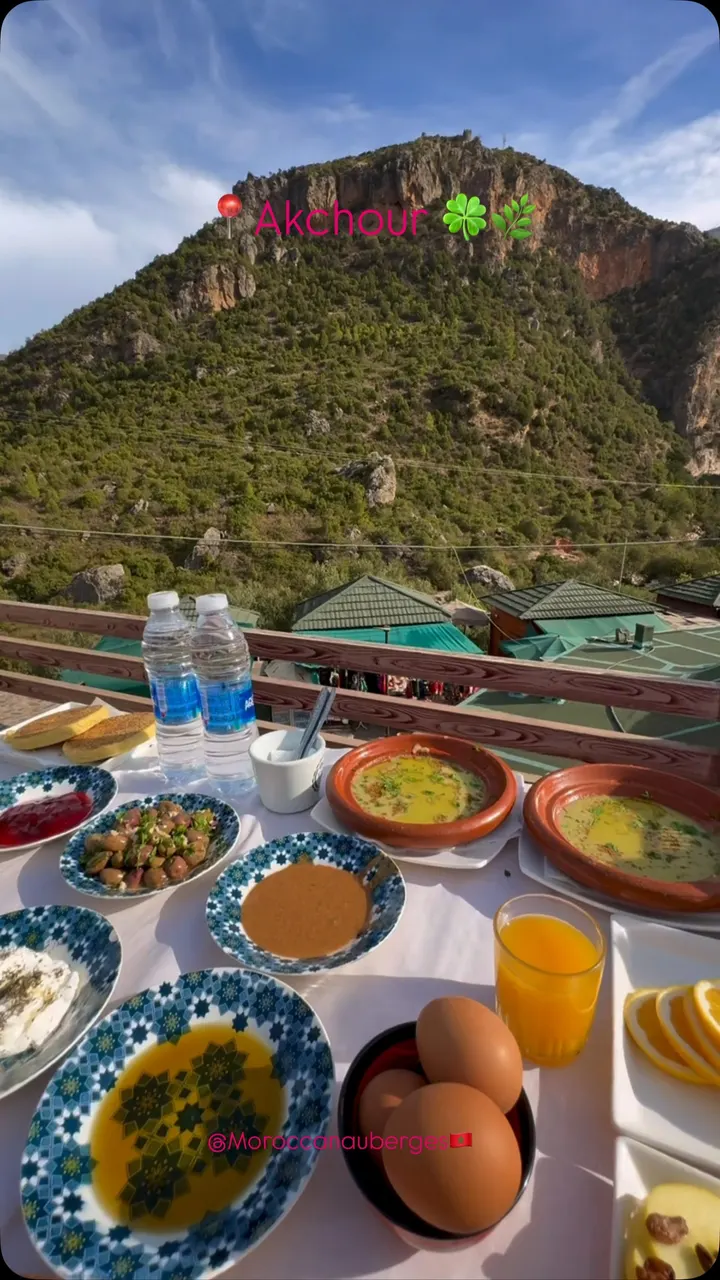
Akchour: sleeping at the foot of the falls, in Talassemtane park
Akchour is first of all a sound: running water, constantly, at the bottom of a Rif valley. The village is a gateway into Talassemtane National Park, 30 km from Chefchaouen, and you will visit it with wet feet more often than dry ones. Here is what the official sources say about this patch of mountain, and where to spend the night.
Where is Akchour?
Akchour is a small village in northern Morocco, 30 km from Chefchaouen on the road to Oued Laou, at the far end of the Talembote valley. It has drawn more and more visitors since Talassemtane nature park opened: that proximity, rather than any tourist infrastructure, is what made its name.
The Moroccan National Tourism Office indeed lists the Akchour waterfalls and Talassemtane National Park at the top of the five most popular topics for Chefchaouen, ahead of the Grand Mosque, the carpet stores and the old medina.
What is Talassemtane park?
A national park in the Rif region of northern Morocco, on the limestone ridge of the western-central Rif. The figures fit in one table.
| Marker | What the sources say |
|---|---|
| Area | 58,950 hectares, that is 589.5 km² |
| Elevation | between 350 and 1,050 metres |
| Created | October 2004, to conserve the last of Morocco’s threatened fir forests |
| UNESCO | added to the World Heritage Tentative List on 12 October 1998, in the natural category |
| Rainfall | from 500 mm a year in the eastern valleys to more than 2,000 mm on the summits |
| Flora | over 1,380 plant species recorded, 47 of them endemic to Morocco |
The park is part of the Intercontinental Biosphere Reserve of the Mediterranean. It holds the only Spanish firs native to Morocco, in its heart, under the highest level of protection, along with the endangered Atlas cedar. As for wildlife: Barbary macaques, otter, lynx, Greek tortoises, and more than a hundred bird species including the bearded vulture — enough for BirdLife International to designate the park an Important Bird Area. The species behind that designation are worth naming: Barbary partridges, red-necked nightjars, Levaillant’s woodpeckers, subalpine and Sardinian warblers, spotless starlings, Moussier’s redstarts, and black-eared and black wheatears.
The flora comes down to a list of Latin names that botanists always cite in the same order: Abies maroccana, the Moroccan fir, endemic, which forms the park’s most singular forest; Cedrus atlantica, the Atlas cedar; then oaks, pines, Tetraclinis articulata, Buxus balearica and Olea silvestris. The area was the subject of a multidisciplinary scientific survey by the Scientific Institute of Rabat as early as July 1961, and the available information remains, by the sources’ own admission, scarce.
What is there to see on site?
The park attractions named by the sources are the Bridge of God, a natural bridge formation, and the villages of El Kalaá and Akchour. The park’s proximity to Chefchaouen, a popular tourist destination, makes it a common hiking destination: the Moroccan National Tourism Office describes the surrounding mountain paths as fine walking country that opens onto another side of Morocco, that of the Rif mountain range.
The landscape itself is made of dome-shaped or peaked summits — Jebel Tissouka overlooks Chefchaouen — of cliffs, and of deep, narrow gorges.
When should you go?
The park ranges from a temperate subhumid bioclimate at low altitude to cold and very cold perhumid conditions on the high ground. In practice: the Akchour valley is the mild part, the ridges are another matter. Snow cover is described as light, but rainfall is considerable, from 500 mm a year in the eastern valleys to more than 2,000 mm on the summits. The water you came to see comes from there — and a valley that takes in that much rain deserves proper shoes.
And Chefchaouen, in all this?
Thirty kilometres away, the blue city is worth a day. Built on a mountainside, its blue-and-white washed houses give it the unreal air that made its reputation. Its medina is small but authentic: walking its narrow winding alleys is a chance to mingle with the local population and to catch the smells of the everyday, freshly baked bread, carefully prepared tagines. Its kasbah, standing in the middle of the old quarter, holds lush gardens — a haven of freshness in the centre of the city — and a museum with a collection of old weapons, photographs of the city and textiles.
The Moroccan National Tourism Office, for its part, files Chefchaouen’s crafts, its ethnographic museum and the Ras Elma spring under the town’s must-sees.
How much driving does it take to get there?
Chefchaouen is the unavoidable staging post, and the office gives precise road distances: 64.9 km and 1 h 26 from Tetouan, 112.4 km and 2 h 11 from Tangier, 194 km and 3 h 24 from Fez. Then add the 30 km that lead to Akchour along the Oued Laou road. Put another way: nobody passes through Akchour by accident.
Where can you stay in Akchour?
The address we know on site is at the bottom of this page, with a link to talk it over directly on WhatsApp. If you would rather pick a region first, have a look at the six regions we cover. And for another Moroccan mountain, higher and colder, our Ifrane and Lake Dayat Aoua guide takes you into the Middle Atlas.
Frequently asked questions
Is Akchour far from Chefchaouen?
Akchour sits 30 kilometres from Chefchaouen, on the road to Oued Laou, at the far end of the Talembote valley. It is that proximity to Chefchaouen that makes the park a common hiking destination.
What is Talassemtane National Park?
A 58,950-hectare park on the limestone ridge of the western-central Rif, created in October 2004 to conserve the last of Morocco's threatened fir forests. It is part of the Intercontinental Biosphere Reserve of the Mediterranean.
What wildlife might you meet on the trails?
The park shelters rare and endemic species: Barbary macaque, otter, lynx. More than a hundred bird species have been observed there, including the bearded vulture, which earned it an Important Bird Area designation from BirdLife International.
Does it snow at Akchour in winter?
Snow cover is described as light over Talassemtane park. Rainfall, on the other hand, is considerable: from 500 mm a year in the eastern valleys to more than 2,000 mm on the mountain summits.
Stays from this guide